Field note
Food Packaging Materials Malaysia: A Practical Comparison For F&B SMEs
Compare food packaging materials for Malaysian F&B SMEs using food-contact checks, delivery trials, total cost and realistic recovery routes.
Published 15/10/2026
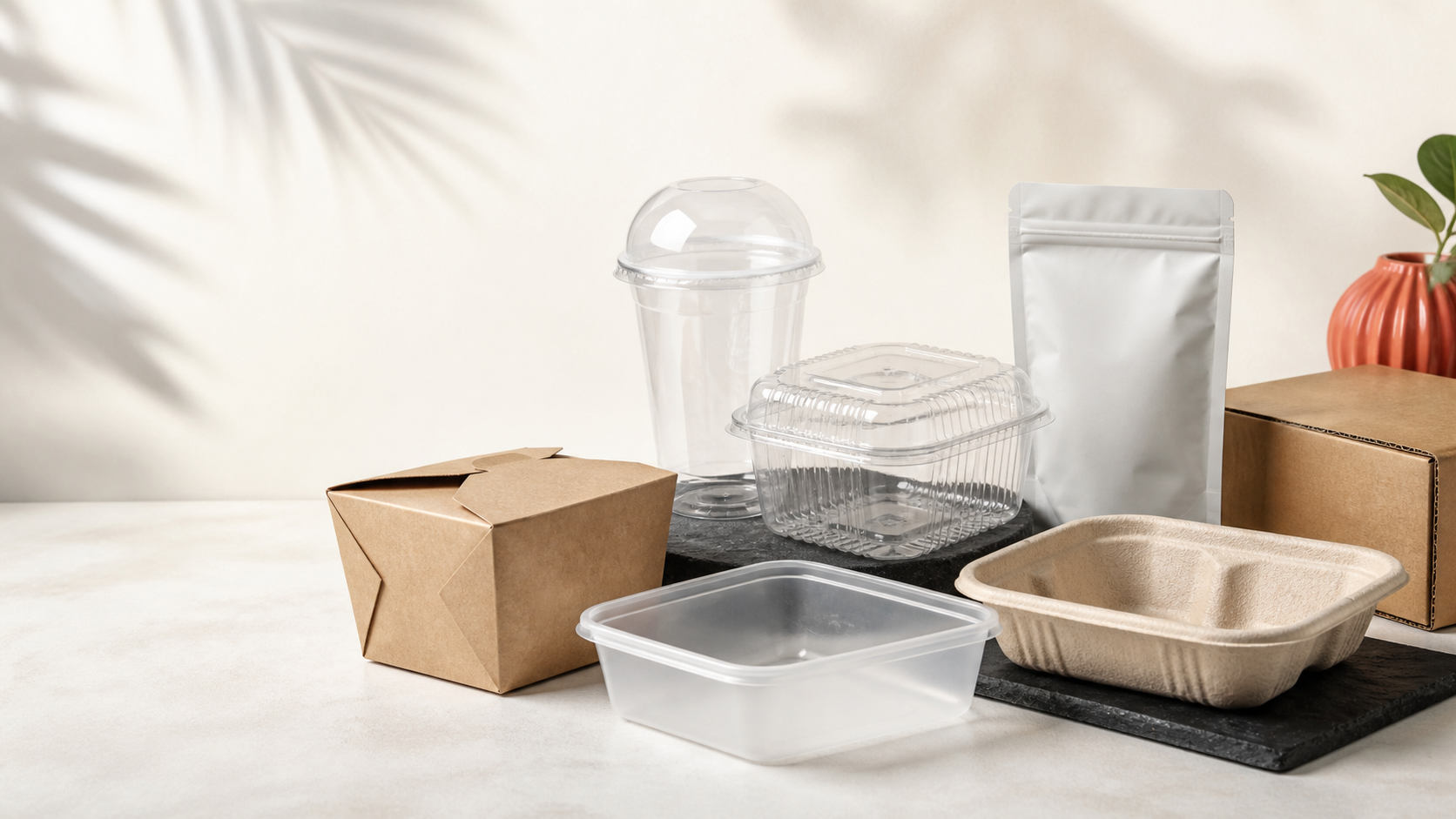
A packaging material can look economical on a quotation and become expensive after the first leaking delivery. This guide to food packaging materials Malaysia is for Malaysian F&B SME owners, procurement teams and packaging buyers who need to compare options without relying on vague labels such as “premium”, “food grade” or “eco-friendly”.
The practical answer is to judge the complete packaging system, not just the headline material, against five factors: food protection, handling, transport, food-waste risk and the recovery route that customers can realistically use.
Key takeaway: Eliminate any option that fails food safety or product protection, test the remaining packs under real operating conditions, and only then compare cost, presentation and end-of-life claims.
A useful material comparison begins with the food and delivery journey, not with a catalogue of containers.
Why The Material Name Does Not Tell The Whole Story
“Paper”, “plastic” and “compostable” describe broad material families. They do not tell a buyer whether a pack will resist hot oil, hold a seal, survive stacking, preserve crispness or enter a recovery system after use.
A paperboard box may contain a barrier coating. A plastic tray may use one polymer, while its film lid, label and adhesive use others. A fibre bowl may be paired with a separate plastic lid. These details can change performance and recovery prospects even when the main material looks familiar.
The packed product matters just as much. Hot curry, frozen pastries, carbonated drinks and dry biscuits expose packaging to different combinations of heat, moisture, grease, oxygen, pressure and handling.
The best material is not the one with the simplest label. It is the one that protects the food with the least unnecessary system impact.
Start With Non-negotiable Food-contact And Protection Requirements
Malaysia’s Food Regulations prohibit packaging that releases, or may release, poisonous, harmful or tainting substances into food, or that assists deterioration. A broad “food grade” statement is therefore not enough to establish suitability for every product and use condition.
Before comparing appearance or sustainability claims, ask for documentation relevant to the actual application:
- A food-contact declaration identifying the material and intended type of food.
- Evidence relevant to the expected contact time and temperature.
- Any limitations involving fatty, acidic, alcoholic, frozen or hot-filled products.
- Information about inks, coatings, adhesives and other components that may affect the pack.
- Material specifications, batch identification and a process for handling specification changes.
These checks are trust boundaries. If an option cannot establish suitable food contact or reliably protect the product, remove it from the commercial comparison rather than compensating with a lower score elsewhere.
Compare The Main Material Families By Use Case
The following comparison is a screening tool, not a universal ranking. Actual results depend on the grade, structure, closure, coating, manufacturing quality and food-contact conditions.
| Material family | Where it can work well | Questions to investigate | Recovery reality to verify |
|---|---|---|---|
| Paper and paperboard | Dry foods, sleeves, cartons and secondary packaging. Printable surfaces can support a refined brand presentation. | Will steam, condensation, grease or sauces weaken the structure? What barrier, coating or window has been added? | Clean, simple fibre structures have a clearer route than food-soiled or heavily coated combinations. Acceptance must be checked locally. |
| Moulded fibre and bagasse | Trays, bowls and hinged formats for some takeaway meals. The texture can communicate a natural, informal character. | Does the pack soften, leak or lose closure strength with hot, wet or oily food? Is a separate lid required? | Do not treat “plant-based” as proof of local compostability. Check the intended facility, collection route and contamination rules. |
| Polypropylene | Many rigid tubs, cups and takeaway containers where moisture and grease resistance are important. | Is the specific grade suitable for the filling, reheating, freezing and contact conditions? Will the closure remain secure? | A technically recyclable polymer is not automatically collected or recycled in every format. Colour, labels, food residue and local demand matter. |
| PET | Clear bottles, cups and some trays where visibility and stiffness support product presentation. | Is the grade designed for the actual temperature? Will clarity create condensation or scuffing concerns during display? | Bottle and tray recovery can differ. Verify the precise format rather than assuming that all PET follows the same route. |
| Polyethylene films | Liners, wraps, pouches and some frozen or dry-food applications where flexibility and moisture control are useful. | What barrier and seal strength does the film provide? Is it a single polymer or a multilayer structure? | Lightweight flexible packaging may face collection, sorting and contamination barriers even when its polymer is recyclable in principle. |
| Multilayer laminates | Products requiring strong barriers against moisture, oxygen, aroma or light. | Is the added shelf-life or protection benefit necessary and demonstrated? Can the structure be simplified without increasing spoilage? | Bonded layers can be difficult to separate in conventional mechanical recycling systems. Ask for a named, accessible route before making recovery claims. |
| Aluminium | Trays, lids and containers requiring strong barriers or compatibility with certain heating processes. | Will the container dent, react with the product or require a different material for its lid, sleeve or coating? | Recovery depends on collection, food residue and the separability of attached components. |
| Glass | Products where barrier performance, chemical stability, visibility or a substantial premium feel is important. | Can operations and delivery tolerate its weight and breakage risk? Is a reuse loop practical? | Recycling or reuse requires collection and transport. A returnable format only works when returns are convenient and consistently managed. |
Protection Deserves More Weight Than Packaging Mass Alone
In 2022, approximately 1.05 billion tonnes of food were wasted globally at household, food-service and retail levels, equivalent to about 132 kilograms per person and 19% of the food available to consumers. This does not prove that more packaging is always better, but it does show why preventing avoidable food loss belongs in a packaging decision.
A lighter pack is not an improvement if weak seals, moisture transfer or crushing cause more meals to be rejected. Extra layers and oversized components should not be retained merely because they feel safer. The buyer’s task is to find the minimum packaging system that delivers the required protection reliably.
Track food loss during trials in units, grams and ringgit. Record whether the cause was leakage, breakage, temperature abuse, condensation, loss of crispness, contamination, premature staling or customer handling.
One failed seal that discards a complete meal can outweigh several grams removed from the container.
Test Food Packaging Materials Malaysia Businesses Use Under Local Conditions
Food packaging materials Malaysia buyers evaluate should be exposed to the journey customers actually experience. That may include a humid kitchen, hot filling, chilled storage, freezer cycling, stacking in a vehicle, motorcycle delivery, sudden braking and time inside a closed delivery bag.
A simple trial is more informative than comparing untouched samples on a meeting table:
- Use the real product. Fill at the normal portion weight and operating temperature, including sauces, garnishes and inserts.
- Test the complete system. Include the lid, seal, liner, label, cutlery or sleeve where applicable.
- Observe over time. Check representative units immediately and at realistic handover or delivery intervals.
- Recreate transport. Stack the normal order quantity and run representative routes, turns, stops and carrying positions.
- Inspect the food as well as the pack. Record temperature where operationally relevant, texture, aroma, leakage, deformation, condensation and ease of opening.
- Repeat. One successful pack is an anecdote. Test across multiple production batches, operators and delivery runs before approving a change.
Set pass-or-fail criteria before the trial. This prevents a visually attractive option from being accepted after a failure is reinterpreted as “probably unusual”.
Use The PACT-R Scorecard After The Safety Gates
A practical way to compare shortlisted food packaging materials Malaysia options is the PACT-R scorecard: Protection, Actual handling, Commercial system cost, Touchpoint experience and Recovery. It keeps a decision anchored to the product journey while making trade-offs visible to finance, operations and marketing teams.
| Criterion | Suggested starting weight | What to measure |
|---|---|---|
| Protection | 30% | Seal integrity, leakage, barrier needs, portion security, shelf-life evidence and food rejected. |
| Actual handling | 20% | Filling speed, nesting, closure consistency, storage space, stacking and delivery damage. |
| Commercial system cost | 20% | Container, lid, label, secondary packaging, labour, storage, transport cube and failure cost. |
| Touchpoint experience | 15% | Opening, dispensing, reheating instructions, portion visibility, accessibility and premium perception. |
| Recovery | 15% | Material identification, separability, food residue, collection access and evidence for any disposal claim. |
Adjust the weights to match the product. Delivery soup may place more weight on protection and handling. A giftable shelf-stable product may place more on presentation, barrier life and secondary-pack efficiency.
Score each option from one to five, multiply by the agreed weight and attach evidence to every score. A team should be able to see whether “four out of five” came from a test result, a document or an assumption that still needs checking.
Calculate Total System Cost, Not Container Price
Unit price is visible. Operational friction is often hidden. A fair comparison includes every component and process that changes with the option.
- Container, lid, seal, sleeve, label and secondary packaging.
- Storage space and the number of units that can be kept at the outlet.
- Assembly, filling, sealing and labelling time.
- Carton size, vehicle space and stack stability.
- Damaged packs, remakes, refunds and discarded food.
- Menu or portion changes required to make the pack work.
- Customer instructions and staff training.
Do not invent precision when quotations or operating data are incomplete. Use a range, record the assumption and rerun the comparison when real numbers arrive.
Judge Premium Perception Through Use, Not Decoration Alone
Premium perception can come from restraint: a closure that aligns cleanly, a surface that does not become greasy, typography that remains legible and a pack that opens without spilling. Added foil, windows, laminates or sleeves may increase visual richness, but they can also introduce more components and complicate recovery.
Test unbranded prototypes first to expose structural differences. Add graphics in a second round and ask users about grip, opening, portion visibility, mess, reheating instructions and disposal, not only which design looks expensive.
A finish should solve a defined presentation or performance problem. If the same effect can be achieved through structure, colour discipline or better information design, an additional layer may not be necessary.
Make Recovery Claims Specific To A Real Malaysian Route
Malaysia’s plastics strategy recognises that circularity requires action across design, collection, sorting and end-of-life treatment. This matters because recyclability is a chain of conditions, not a property proven by a recycling symbol alone.
Before using terms such as recyclable, compostable or reusable, answer five questions:
- What is the complete material structure, including lids, coatings, labels and adhesives?
- Can the customer separate the components easily and safely?
- How much food residue normally remains?
- Who collects this exact format in the markets where it will be sold?
- Where does it go next, and is that route operating at a meaningful scale?
If the answer depends on a facility that customers cannot access, present it as a technical possibility rather than an expected outcome. “Check local collection” is more accurate than a universal disposal promise, although it places more responsibility on the brand to investigate and communicate clearly.
The same discipline applies to compostable packaging. Certification for a defined composting condition does not demonstrate that the pack will break down in every home compost, landfill or natural environment.
A Worked Decision Example: Hot Noodle Delivery
Consider a noodle business replacing a rigid plastic bowl. A moulded-fibre bowl may initially appear preferable because its main body is fibre, while a lighter plastic bowl may appear preferable because it uses less material.
The comparison changes after the complete journey is mapped. Hot broth tests closure security and heat resistance. Steam may soften fibre or create condensation. A separate lid changes material composition. Stacking tests reveal whether lower bowls deform, while a delivery trial shows whether movement pushes liquid into the closure.
The team should reject any option that cannot safely hold the product, then compare food loss, packing time, customer use, total system cost and the locally available recovery route. The winner cannot be identified from material names alone.
Questions To Ask Before Approving A Packaging Change
- What exact food, portion, temperature and contact time was this format designed for?
- Which components are included in the quoted system?
- What evidence supports shelf life, barrier performance and food-contact suitability?
- What variation should operations expect between batches?
- Will the current filling, sealing, storage and delivery process need to change?
- Which claim can the business support about recycling, composting or reuse?
- What event would trigger a review: leakage, complaint rate, material change or new collection route?
Frequently Asked Questions
Is Paper Always More Sustainable Than Plastic For Food Packaging?
No. The answer depends on product protection, material quantity, coatings, manufacturing, transport, food waste and what happens after use. A comparison should examine the complete system under the same functional requirements.
Does A Recycling Symbol Mean The Pack Will Be Recycled In Malaysia?
No. A symbol may identify a material, but actual recovery also requires collection, sorting, acceptable contamination levels, processing capacity and demand for the recovered material. Check the exact format and location.
Can An SME Rely On A “food Grade” Statement?
Treat it as the start of due diligence, not the end. Ask whether the evidence covers the specific food type, temperature, duration and intended use, including reheating or freezing where applicable.
Should Packaging Cost Be Compared Per Unit?
Unit price is useful but incomplete. Include closures, labels, labour, storage, transport space, damage, remakes and discarded food to compare the cost of the full system.
How Many Materials Should Be Tested?
Shortlist the smallest number that can meet the non-negotiable requirements. Two or three well-defined systems usually produce a clearer trial than a large collection of poorly documented samples.
Next Step: Run A Documented Side-by-side Trial
Select two or three viable systems, agree on pass-or-fail protection criteria and use the PACT-R scorecard to record the same evidence for each. Keep samples, photographs, operating notes and failure counts so the final decision can be reviewed rather than reconstructed from memory.
For further material and finish comparisons, continue with BoxMany’s packaging education resources and apply the same product-first questions to each option. A defensible decision protects the food, works in daily operations and describes its recovery route honestly.