Field note
Matte Lamination Versus Soft-Touch Coating: How Malaysian Premium Packaging Buyers Should Choose
A practical guide for Malaysian packaging buyers comparing matte lamination and soft-touch coating by appearance, feel, durability, production needs and end-of-life considerations.
Published 03/07/2026
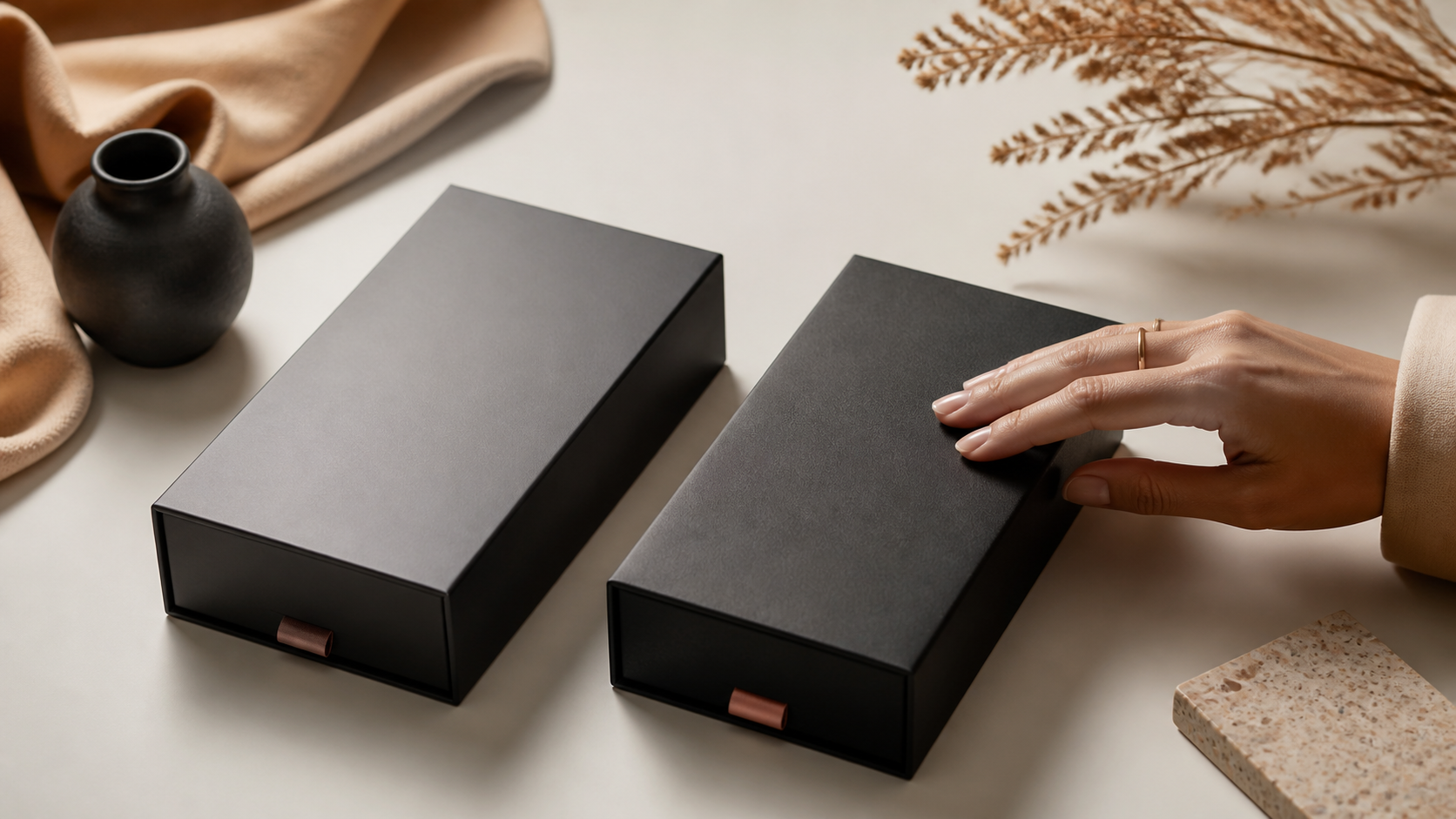
For Malaysian brand owners, marketing teams, procurement teams and packaging buyers, matte lamination versus soft-touch coating is not simply a choice between two premium-looking finishes. Matte lamination adds a bonded film that usually prioritises a quiet, low-glare appearance and surface protection, while soft-touch coating applies a liquid formulation that makes tactility a more prominent part of the experience.
Neither option is universally more premium, durable, economical or sustainable. The defensible choice depends on the actual paperboard, inks, finish product, converting sequence, handling conditions and brand proposition.
Key takeaway: Specify the construction first, then compare production-intent samples under representative Malaysian storage, distribution and handling conditions. A finish name alone cannot predict colour, touch, durability, converting performance or recovery outcomes.
At A Glance: Match The Finish To The Job
- Choose matte lamination for visual restraint: Shortlist it when low glare and the protective contribution of a bonded film are the leading priorities.
- Choose soft-touch coating for tactile impact: Shortlist it when a warm, velvety feel is central to the intended customer experience.
- Do not choose by finish name alone: Film, adhesive, coating chemistry, board, ink coverage and converting sequence all affect performance.
- Approve the finished construction: Test production-intent cartons under representative Malaysian storage, distribution and handling conditions.
Direct Answer: Which Finish Fits Which Premium-packaging Objective?
Shortlist matte lamination when the leading objective is a restrained, low-reflection appearance combined with the potential protective contribution of a film. Shortlist a soft-touch coating when a warm, velvety tactile cue is intended to play a deliberate role in the customer experience.
The more useful question is not “Which finish is better?” It is “Which construction produces the intended experience and survives the real supply chain?” That distinction matters in Malaysia, where high humidity, substantial rainfall, air-conditioned interiors and warm loading environments can expose paperboard packs to changing conditions.
This article compares finish categories. It does not promise the availability, specification or performance of any printer, converter, coating producer or packaging supplier.
Start With Construction, Not Finish Names
What Matte Lamination Adds To A Carton
Film lamination bonds a thin film to the printed surface with an adhesive. The resulting construction may therefore include paperboard, ink, adhesive and film rather than paperboard and print alone.
The word “matte” describes a low-reflection visual result. It does not identify one film chemistry, adhesive system, thickness or guaranteed resistance level. Two samples described as matte laminated may perform differently because their underlying materials and processes differ.
When evaluating matte lamination for premium packaging, request the film and adhesive specification rather than approving the finish solely from its name. Also confirm whether the film covers the entire printed face, stops at particular zones or crosses folds and glued areas.
What A Soft-touch Coating Adds
A soft-touch coating is applied as a liquid layer and formulated to produce a dull-matte surface with a warm, velvety or sometimes leather-like feel. Water-based systems exist, but the term “soft touch” does not by itself identify the coating chemistry, application method, coat weight or resistance properties.
The purpose of soft-touch coating for premium packaging is usually more tactile than visual. Its surface may look matte, but its distinguishing role is often revealed when a person picks up, opens or repeatedly handles the pack.
That sensory effect should be treated as a design decision, not an automatic upgrade. A plush surface may support one brand proposition while feeling unnecessary or incongruent on another.
Soft-touch Coating Vs Soft-touch Laminate
The comparison of soft-touch coating vs soft-touch laminate is separate from the comparison between an ordinary matte film and a liquid soft-touch layer. Buyers may encounter at least three different constructions:
- An ordinary matte film laminate selected mainly for low reflectivity and surface protection.
- A liquid soft-touch coating formulated to create a distinctive tactile response.
- A soft-touch laminate using a film engineered to provide a particular hand feel.
These terms should not be collapsed into a request for “matte soft touch.” In a brief or quotation, state whether the finish must be a film or liquid coating, then describe the target sheen, feel, resistance and converting requirements.
A premium finish should be specified as a construction and an experience, not as a fashionable name.
Appearance: Quiet Matte Presentation Versus Touch-led Character
A Restrained Surface For Printed Graphics
Compared with gloss, a matte laminate usually reduces glare and presents printed graphics in a quieter, less reflective way. This can suit cosmetics, gifting, wellness products and corporate presentation packs when visual restraint supports the intended identity, although no single finish should be assumed to be standard for those categories.
The final appearance still depends on the film, board shade, surface smoothness, ink density and artwork. Dark areas may look deeper or flatter, fine details may appear differently under low-reflection material, and contrast can change once the finish is applied.
A Matte Appearance With A Touch-led Character
A soft-touch coating may also produce a dull or matte appearance. Its intended point of difference, however, is generally the tactile response: the package can feel warmer, softer or more sensorial in the hand.
That quality may encourage handling or make an opening sequence more memorable. It can also conflict with a product positioned as clinical, highly technical, functional or intentionally raw. The relevant test is whether the texture supports the product promise, not whether the sample feels luxurious in isolation.
Why A Screen Preview Cannot Settle The Choice
A digital mock-up cannot reproduce reflectivity, surface drag, warmth, texture or the way dark colours reveal fingerprints. Even photography can exaggerate or suppress glare depending on lighting and camera angle.
Review physical samples under the conditions in which the package will be selected and used. This can include retail lighting, office lighting, daylight and the mixed lighting found around packing and storage areas.
Where internal teams are likely to be influenced by finish names or expected prices, run a blind comparison. Label the samples with neutral codes, ask reviewers to handle them in the same sequence and record observations before revealing the construction.
Tactile Feel And Premium Perception Are Contextual
What A 400-person Study Can—and Cannot—show
In a cosmetic-packaging study involving 400 participants, respondents preferred soft-touch coating over no tactile coating even when the soft-touch option was paired with a stated 5% price increase. However, they preferred a raised tactile treatment over the soft-touch finish.
This is useful evidence that tactility can affect preference. It is not proof that every Malaysian customer, product category or sales channel will respond in the same way. The study’s more valuable lesson is that “premium” remains comparative and contextual: soft touch can add value without being the strongest tactile option in every setting.
Matte Surfaces Can Change Product Associations
Experiments involving food packaging found that matte surfaces could increase perceived naturalness for products initially regarded as relatively artificial. The effect did not extend in the same way to products already perceived as natural.
This challenges the assumption that matte automatically signals naturalness or premium quality. A surface treatment can reinforce an association that the audience is ready to make, but it cannot be expected to create the same meaning for every product.
Match The Texture To The Product Promise
Visual and tactile congruence can influence how people evaluate a packaged product. A soft, sensorial finish may support the ritual associated with skincare, for example, while a crisp technical product may benefit from a more controlled, less plush surface.
These are hypotheses to test with the intended audience, not category rules. Compare prototypes with the product inside, the proposed graphics applied and the intended opening sequence in place.
Durability: Compare Systems, Not Labels
What A Matte Laminate May Protect Against
A laminate film can help protect print from scuffing, handling marks, moisture exposure and shelf wear. The actual result depends on the film, adhesive, ink, paperboard, exposed edges, folds and use conditions.
Inspect more than the broad front panel. Relevant failure modes include visible scuffs, stress whitening, cracking at scores, edge lifting and delamination. A visually clean flat sheet can still fail after cutting, creasing, folding, gluing and packing.
Why Soft-touch Coating Should Not Be Assumed Weaker
Soft-touch performance is formulation-specific. Published systems demonstrate that abrasion, water and alcohol resistance can be engineered into particular coatings, while cross-linking may improve abrasion resistance in some systems.
A technical data sheet for one coating is not a category-wide guarantee. Ask what formulation, application conditions and curing process will be used, then test that proposed system on the intended carton.
Fingerprints, Oils And Repeated Handling
Dark solid colours and frequently handled packs can reveal fingerprints, skin oils, rubbing and cleaning marks differently. Test the actual colour coverage instead of relying on a pale generic swatch.
Use filled or appropriately weighted packs, because weight changes how surfaces are gripped and how panels rub against one another. Record observations after:
- Packing and case loading.
- A representative transport simulation.
- Shelf display and repeated handling.
- Multiple opening and closing cycles.
- Any realistic wiping or cleaning procedure.
For matte lamination versus soft-touch coating, durability should mean continued fitness for the intended use—not the absence of every microscopic mark.
Packaging Finishes For Humid Climates: A Malaysia-relevant Test Plan
Why Local Use Conditions Matter
Malaysia’s climate is characterised by high humidity and substantial rainfall. Paperboard packs may move between air-conditioned storage, warm loading areas, vehicles, retail environments and customer homes, creating repeated changes in temperature and moisture exposure.
Those transitions may affect more than the decorative surface. Board movement, adhesive behaviour, folds, seams and the interaction between layers can all influence the appearance and integrity of the completed package.
Premium Packaging Durability Testing Malaysia Teams Can Specify
A useful programme for premium packaging durability testing Malaysia teams can specify should examine the fully converted pack rather than relying only on flat print samples or finish literature.
Check the complete carton for:
- Changes in colour, gloss and tactile feel.
- Blocking, where adjacent surfaces stick together.
- Curl, distortion or loss of panel alignment.
- Unexpected odour after conditioning.
- Rub marks, ink transfer or coating transfer.
- Cracking or whitening along folds and scores.
- Loss of glue integrity at seams or flaps.
- Edge lift, bubbling or delamination.
Damp-heat cycling is one relevant test concept because it exposes samples to high humidity and cyclic temperature changes, potentially including condensation. MS IEC 60068-2-30:2008 provides a formal reference for this type of testing, but that does not mean every carton must follow one identical protocol. Select the duration, severity and acceptance criteria for the actual product and supply chain.
A Minimum Useful Sample Matrix
Compare the actual proposed matte laminate and soft-touch coating on the same board, artwork and ink coverage. Include light and dark artwork, folds, glued seams, foil or varnish zones and areas likely to receive frequent contact.
Keep unconditioned control samples beside conditioned samples so changes are easier to see. If multiple board or ink systems remain under consideration, treat each combination as a separate construction rather than assuming the finish will behave consistently across them.
Define acceptance criteria before testing. These may cover allowable colour change, visible scuffing at a specified viewing distance, tactile change, blocking, fold cracking and structural failure. Without agreed criteria, teams can observe the same result and reach different approval decisions.
Printing, Folding, Gluing And Decorative Finishes
Approve Colour On The Intended Construction
Finishes can alter perceived colour, contrast and reflectivity. Approve colour on the intended board with the intended inks and final surface treatment—not from a screen, an unrelated swatch or an unfinished press sheet.
Pay particular attention to dense dark colours, subtle gradients, skin tones and small reversed text. Review both broad viewing angles and the oblique angles at which low-glare and tactile surfaces reveal their character.
Soft-touch Coating Finishing Compatibility Requires Trials
Soft-touch coating finishing compatibility with foil, glue, UV varnish and other downstream treatments cannot be inferred from the phrase “soft touch.” Published technical guidance calls for application trials and separate checks for foil suitability.
Clarify the order in which ink, coating, foil, varnish, embossing and gluing will be applied. Changing that sequence may change adhesion, visual registration, surface feel or rub performance.
Protect Folds, Adhesive Zones And Functional Surfaces
Ask whether the finish will cross fold lines, glue flaps, windows, embossed areas, label zones, coding areas or sealing surfaces. A finish that performs well on the main panel may still interfere with a functional zone.
Evaluate scoring, cracking, adhesion and rubbing after the complete converting sequence. Production-intent samples should use the actual board, ink coverage, finish formulation and process order wherever practical.
Commercial And Environmental Trade-offs Without Unsupported Claims
Cost Should Be Quoted Against A Defined Construction
Comparing generic “matte” and “soft touch” prices is unreliable. Board choice, artwork, coverage, film or coating specification, tooling, run conditions, finishing sequence, quality criteria and expected wastage can all affect a quotation.
Request like-for-like quotations that identify the proposed construction and included tests. Do not compare one price that includes conditioning, converting trials and documented inspection with another that covers only an unspecified surface finish.
No general Malaysian price, lead-time or minimum-order assumption can replace a project-specific quotation.
Matte Lamination Recyclability Requires Local Verification
Matte lamination recyclability cannot be determined from appearance alone. A laminated carton combines paperboard with an added film and adhesive, so its recovery outcome may differ from that of plain board or a carton carrying a liquid-applied coating.
Do not describe a construction as recyclable, non-recyclable, plastic-free or more sustainable without evidence for the exact materials. Request material declarations and verify acceptance through the relevant Malaysian collection, sorting and mill pathways.
The same caution applies to liquid coatings. “Water-based” identifies a feature of the application system; it does not by itself settle the complete pack’s environmental performance, recyclability or local acceptance.
Compare Total Decision Risk, Not Only Unit Price
The commercial comparison should include sampling, rejected appearance, packing-line disruption, distribution damage and inconsistent tactile results. These risks should be balanced against the potential value of protection, visual restraint, tactile differentiation and better brand fit.
Treat the premium packaging finishes Malaysia buyers consider as commercial hypotheses that require evidence. The lowest quoted unit price may not be the lowest-risk construction, and the most expensive finish name may not create the strongest customer response.
Decision Framework: Matte Lamination Versus Soft-touch Coating
Shortlist Matte Lamination When
- A quiet, low-reflection visual result is the leading objective.
- The added film protection is desirable and verified on the actual pack.
- The multilayer construction is acceptable within the project’s environmental and recovery requirements.
- Folding, gluing and decorative-finishing trials meet defined criteria.
Shortlist Soft-touch Coating When
- A warm, velvety tactile cue is central to the intended brand experience.
- The chosen formulation passes the required abrasion, water, alcohol, fingerprint and handling tests.
- Foil, varnish, glue and other finishing compatibility has been demonstrated through trials.
- The coating construction fits the brief after cost and recovery considerations are verified.
Do Not Approve Either Option Until
- The structural specification is unambiguous.
- Samples reproduce the intended board, ink coverage and converting sequence.
- Tests represent Malaysian storage, handling and distribution conditions.
- The result has been reviewed for visual fit, tactile congruence, durability, packing performance, cost and end-of-life assumptions.
- Acceptance criteria and responsibility for deviations are documented.
Compact Buyer Comparison
| Decision factor | Matte film lamination | Liquid soft-touch coating | Buyer verification question |
|---|---|---|---|
| Construction | Film bonded over print with adhesive. | Liquid-applied coating layer. | What exact film, adhesive or coating formulation is proposed? |
| Primary sensory cue | Usually visual restraint with a smooth matte surface. | Usually a warm, velvety or leather-like tactile response. | Is appearance or touch the leading objective? |
| Reflectivity | Normally low glare, but depends on film and substrate. | May be dull matte, but depends on formulation and application. | What gloss range is acceptable on the final artwork? |
| Colour effect | May change perceived depth, contrast and sharpness. | May alter colour and contrast depending on coat weight and surface. | Has colour been approved on the production-intent construction? |
| Scuff and moisture behaviour | Film may add protection; edges, folds and adhesion remain critical. | Resistance depends on formulation, application and curing. | What happens after rubbing, conditioning and distribution simulation? |
| Fingerprint response | Depends on film, colour and handling. | Depends on formulation, colour and surface oils. | Has the filled pack been repeatedly handled by different users? |
| Folding | Inspect for whitening, cracking, lifting and delamination. | Inspect for cracking, rub change and loss of tactile consistency. | Has the finish been tested across actual scores and folds? |
| Gluing | Film may require controlled glue zones or a compatible process. | Adhesion depends on the coating and glue system. | Which surfaces must remain finish-free or glue-compatible? |
| Foil and varnish | Compatibility depends on material and process sequence. | Compatibility cannot be assumed; test the proposed system. | Have all decorative layers been trialled in production order? |
| Humid-condition testing | Check curl, blocking, edge lift, folds and layer adhesion. | Check blocking, tactile change, transfer, folds and glue integrity. | Do the conditions represent storage and distribution transitions? |
| Recycling verification | Added film and adhesive create a multilayer structure. | Outcome depends on the exact coating and complete pack. | What evidence supports acceptance in relevant Malaysian pathways? |
| Commercial variables | Film, adhesive, board, coverage, converting and quality criteria. | Formulation, coverage, application, curing, converting and quality criteria. | Are quotations based on the same artwork, tests and acceptance criteria? |
Frequently Asked Questions
Is Soft-touch Coating Always More Premium Than Matte Lamination?
No. Soft touch can make tactility more noticeable, but premium perception depends on the fit among material, graphics, texture, product and handling. A restrained matte laminate may be more coherent for a brand that values precision or visual quietness.
Which Finish Is More Durable?
There is no category-wide winner. A film may add useful print protection, while a correctly specified coating may provide engineered abrasion and liquid resistance. Compare the actual proposed systems after printing, converting, conditioning and repeated handling.
Can A Buyer Approve The Finish From A Swatch Book?
A swatch can support early shortlisting, but it cannot reproduce the project’s board, ink density, folds, glue, decorative processes or pack weight. Final approval should use a production-intent sample.
Does Water-based Soft Touch Mean The Carton Is Recyclable?
No automatic conclusion follows from the term “water-based.” Recovery depends on the complete construction and the acceptance requirements of the relevant collection, sorting and mill pathways.
What Is The Most Useful First Comparison?
For an initial matte lamination vs soft-touch coating for packaging review, produce both finishes on the same board and artwork. Include dark ink coverage, folds, glued seams and high-contact surfaces, then compare appearance, touch and handling without revealing the finish names.
Buyer Checklist For A Malaysian Packaging Brief
Use the following questions before requesting final samples or quotations:
- Is the requested surface a matte film laminate, a soft-touch liquid coating or a soft-touch laminate?
- What measurable gloss, tactile and colour outcomes are required?
- Which board, ink system and artwork coverage will be used?
- Which surfaces must remain suitable for glue, foil, UV varnish, labels, coding or sealing?
- What resistance is required against rubbing, fingerprints, water, alcohol or cleaning agents?
- What storage, transport, retail and air-conditioning transitions should samples reproduce?
- What are the pass-or-fail criteria after folding, packing and environmental conditioning?
- What material declarations and Malaysian recovery-pathway evidence are available?
- Who records test results, approves deviations and owns corrective action?
Turn The Comparison Into An Approval Specification
The matte lamination versus soft-touch coating decision should begin with construction and the desired customer experience, then be confirmed through production-intent samples and representative testing. “Premium” is created by the fit among material, graphics, texture, product and handling—not by a finish name alone.
Turn the checklist into a written finish specification, define pass-or-fail criteria and compare physical prototypes before requesting final commercial approval. For more buyer-first packaging guidance, continue to BoxMany.
References
- ERCBOX Packaging — Board Grade, Coating & Lamination
- Netpak — Gloss, Matte and Soft-Touch Lamination for Folding Cartons
- ACTEGA STARKOTE AQ-5011 Technical Data Sheet
- Journal of Applied Packaging Research — Consumer Perception of Tactile Packaging
- Polytex Soft Touch Coating Technical Data Sheet
- Marketing Letters — Matte Matters
- METMalaysia — Malaysia’s Climate
- Standards Malaysia — MS IEC 60068-2-30:2008