Field note
Moulded Fibre Packaging Innovations Malaysian Buyers Should Evaluate
A practical buyer's guide to evaluating moulded fibre packaging through protection, moisture resistance, tooling, safety evidence and end-of-life claims.
Published 13/07/2026
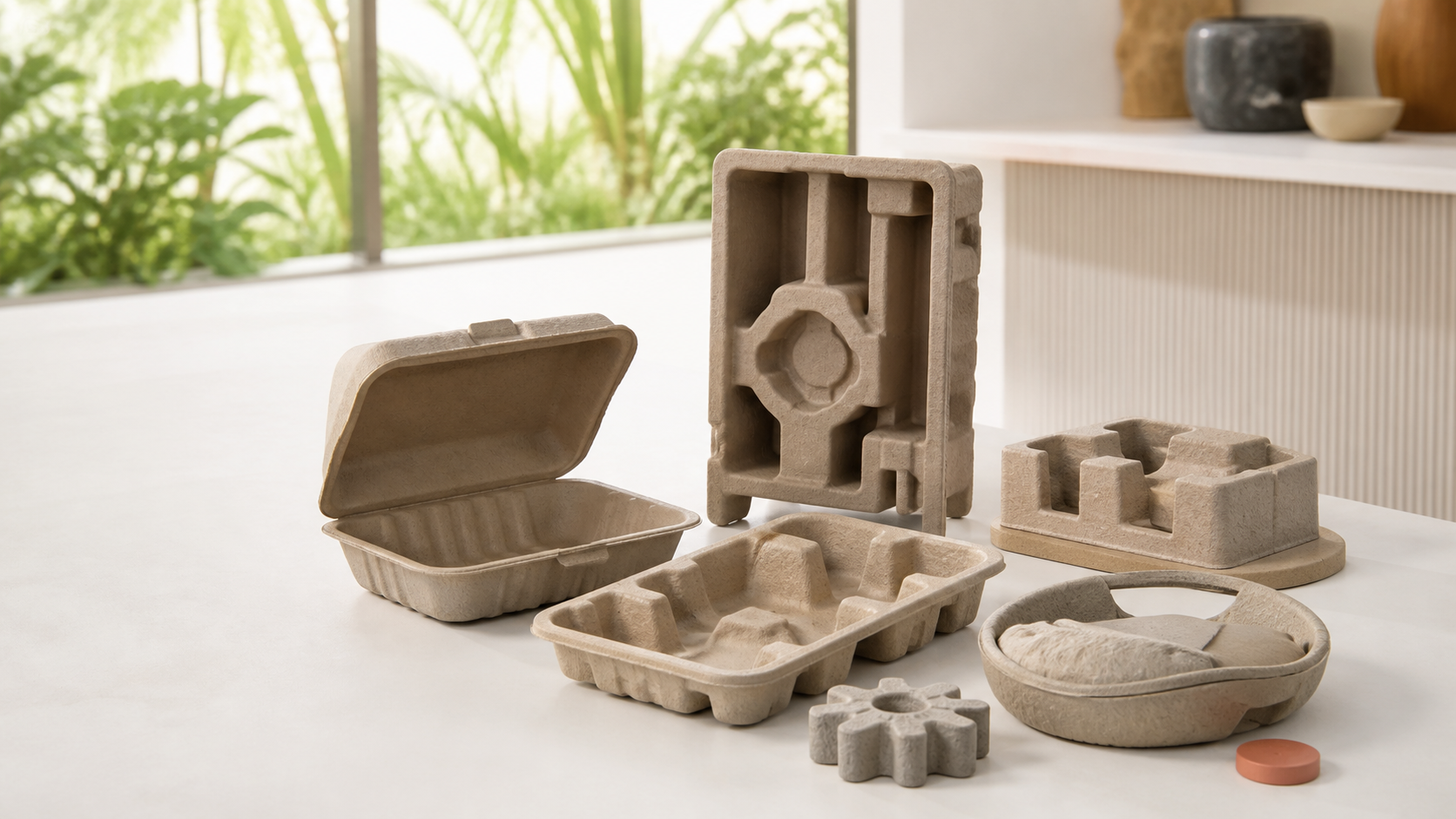
The most useful moulded fibre packaging innovations Malaysia buyers can evaluate are better cushioning structures, moisture and grease treatments, smoother thermoformed parts, more controlled tooling and clearer evidence about safety and recovery. A fibre-based label alone does not show whether a package will protect the product, remain stable in humid conditions or suit the intended disposal route.
Start with five commercial questions. Does the package protect the product? How does it respond to moisture? Can it be manufactured consistently? Does its surface suit the brand and handling conditions? Are its safety and end-of-life claims supported by evidence for the finished construction?
These questions matter in Malaysia, where buyers may need to account for humid storage, rain exposure during handling and products moving between air-conditioned and uncontrolled environments. The right specification depends on the payload, distribution route, presentation standard and realistic recovery options.
A moulded fibre package is an improvement only when the finished pack performs for the product, supply chain and intended recovery route.
This is an educational evaluation framework. BoxMany does not manufacture, print, supply or sell the packaging discussed.
Define The Protection Job Before Comparing Materials
Product protection is the first decision gate. A fibre format is not a useful substitution if it leads to more damaged goods, cosmetic rejects, returns or product waste.
Document the intended payload and distribution hazards before reviewing samples:
- Product mass, dimensions and centre of gravity.
- Fragile components, projections and cosmetic surfaces.
- Permitted movement inside the completed package.
- Expected stacking load and storage duration.
- Likely drop orientations and handling risks.
- Temperature, humidity and water exposure.
- Whether the pack travels alone, in a master carton or on a pallet.
A moulded insert may locate, cradle, separate, stiffen or cushion a product. Each required function should have an acceptance criterion. An insert that holds a lightweight cosmetic bottle may not provide suitable cushioning for a dense appliance component.
Published research indicates that foam-formed cellulose and conventional moulded pulp can provide useful cushioning, while also showing that performance varies by structure and payload. Buyers should test the intended product and package rather than infer protection from material identity.
Use Package-level Tests With Agreed Failure Criteria
Moulded fibre packaging testing Malaysia teams commission should cover the product, insert, closure and outer carton as one system. Testing material coupons alone will not reveal product movement, contact marks, insert release or interactions with the outer pack.
ISTA 3L is one available framework for packaged products moving through individual parcel delivery systems. It covers several distribution hazards, but it is not automatically suitable for every product or route. The selected procedure should reflect actual transport, storage and handling conditions.
Before testing, agree what counts as failure. Criteria may include functional damage, product displacement, cracks, dusting, rub marks, unacceptable deformation or visible changes to a presentation surface.
A useful report should identify the tested configuration, conditioning history, procedure, observations and acceptance limits. A pass statement without this information gives a buyer little basis for comparing constructions.
Measure Retained Performance After Moisture Exposure
Cellulose attracts and exchanges moisture with its surroundings. This makes moulded fibre packaging humidity resistance a question of retained performance, not simply whether a sample shows a water stain.
Moisture exposure can affect:
- Stiffness and compression performance.
- Dimensions and product fit.
- Nesting and denesting behaviour.
- Warping, edge definition and surface appearance.
- Odour and suitability for sensitive goods.
- Adhesion of coatings, inks and labels.
Compare dry and conditioned samples from the same construction. Record dimensions and mass before and after exposure, then assess product retention, deformation, compression performance and recovery. Where relevant, include a defined recovery period to determine whether distortion is temporary or permanent.
Build A Condition-to-failure Comparison
| Condition | Property measured | Acceptance limit | Failure observations |
|---|---|---|---|
| Defined dry environment | Dimensions, retention and compression | Set before testing | Cracks, dusting, movement or marking |
| Representative humid environment | Change from dry baseline | Set before testing | Softening, warping, sticking or loss of fit |
| Defined recovery period | Permanent deformation and restored performance | Set before testing | Residual distortion or weakness |
ISO 535 specifies the Cobb method for measuring water absorptiveness of paper and board under standard conditions. The method is not suitable for every porous, embossed or three-dimensional construction. Buyers should ask the test provider to confirm whether the method fits the moulded part and to justify any alternative.
Review Barriers As Part Of The Complete Formulation
Moulded fibre packaging barrier coatings can improve resistance to water, oil or grease. Fibre blends, sizing agents and other additives may contribute as well. A finished construction can use more than one approach.
Important trade-offs include:
- Barrier performance and repulpability.
- Coating coverage and cracking at corners or flex points.
- Grease resistance and food-contact suitability.
- Surface sealing and water vapour response.
- Treatment chemistry and recovery claims.
- Initial performance and consistency after heat, humidity and handling.
Request information covering the supplied formulation, including fibre furnish, binders, wet-strength agents, pigments, inks, coatings and processing aids. Evidence for untreated base fibre does not establish the behaviour of the treated package.
How To Examine A PFAS Claim
For PFAS-free moulded fibre packaging, ask for a written declaration that defines the substances covered, identifies the included components and applies to the supplied formulation. A general fibre-based or compostable claim does not answer this question.
If the application warrants additional assurance, request relevant analytical or independent evidence. Check whether a statement covers the complete article or only one component, and whether terms such as "no intentionally added" have been clearly defined.
A treatment can improve resistance during use while complicating a recycling or composting claim. Review barrier performance and end-of-life evidence together.
Match Process And Surface Quality To The Use Case
Moulded fibre formats differ in wall thickness, detail, draft, texture and dimensional control. Industry descriptions commonly distinguish thicker products with a rough surface, transfer-moulded products with a smoother face and thermoformed products made with heated tools.
Thermoformed fibre packaging types can offer thinner walls, sharper detail and smoother surfaces than conventional moulded pulp. Buyers should weigh those qualities against tooling requirements, process control and the actual finish needed.
Separate functional requirements from appearance preferences. A rougher part may be appropriate for concealed transport protection. A smoother insert may help locate a component precisely or support a presentation-led unboxing experience. Premium perception still depends on consistent edges, colour, cleanliness, fit and tactility. Smoothness alone does not create it.
Review physical samples under the lighting and handling conditions customers will encounter. Look for fibre show-through, pinholes, warping, unclear edges, loose fibres, rub marks, contamination and colour variation. If the insert sits inside a premium printed carton, evaluate the contrast between the two materials as part of the complete pack.
Evaluate Tooling Through Repeatability And Change Risk
Moulded fibre packaging tooling must account for drainage, drying, fibre distribution, shrinkage, release and trimming. A computer model that fits the product does not by itself establish repeatable production behaviour.
Review:
- Process-specific shrinkage compensation.
- Draft angles and part release.
- Drainage paths and local thickness variation.
- Tool alignment and temperature uniformity.
- Nesting clearances and denesting features.
- Tolerances around ribs, clips, walls and contact points.
- Trim quality and loose-fibre control.
Request prototype or pilot samples before production approval. Where relevant, obtain dimensional data from more than one cavity or production position. Write down tolerances, inspection methods and failure criteria instead of relying on a single approved sample.
Commercial documentation should clarify tooling ownership, storage, maintenance, modification responsibility and change control. A change in fibre furnish, additives, tooling or production location may justify renewed review or testing.
Tighter tolerances can improve fit and presentation, but they can also increase sensitivity to production variation. The useful tolerance is the one that consistently meets the product requirement.
Check Safety Evidence For The Complete Article
Fibre source, drying, additives and post-treatment can affect appearance, odour and performance. Recycled fibre may require application-specific controls when the package will contact food or another sensitive product.
Food-safe moulded fibre packaging Malaysia buyers can approve should be supported by evidence for the complete article and intended conditions of use. Avoid treating the words fibre-based, natural or compostable as food-contact evidence.
Request documentation covering:
- Fibre source and recycled content, where relevant.
- Coatings, sizing agents and wet-strength additives.
- Grease-resistant treatments.
- Inks, pigments and adhesives.
- Intended food type, contact duration and temperature.
- Foreseeable reheating, chilling or oily-food exposure.
Confirm current Malaysian requirements with a competent regulatory or testing specialist for the specific application. Evidence for another colour, coating, formulation, temperature or contact time may not address the intended use.
For non-food products, complete-formulation review can still matter. Odour, abrasion, dust, extractable substances and colour transfer may affect cosmetics, electronics, medical accessories and other sensitive goods.
Demand End-of-life Evidence For The Treated Package
Fibre content, technical recyclability, access to collection and compostability are different claims. One does not prove another.
Ask What Recyclability Testing Actually Covered
Moulded fibre packaging recyclability testing should examine the supplied construction, including coatings, additives and inseparable components. Buyers should request the tested product description, method, laboratory identity, results, limitations and pass criteria.
Ask how labels, adhesives, windows, coatings and other attached components were handled. Laboratory performance should also be considered alongside the collection and processing routes available in the market where the package will be discarded.
Distinguish Industrial Composting From Broader Claims
Compostable moulded fibre packaging standards evaluate more than whether cellulose can biodegrade. A packaging claim may need to account for disintegration, biodegradation, effects on the treatment process and the quality of the resulting compost. Inseparable coatings, inks, labels and adhesives can affect the assessment.
State the applicable composting conditions. Evidence for industrial treatment does not automatically establish performance in household composting, open environments or litter. It also does not prove that users have access to a suitable collection and treatment system.
Moisture and grease treatments may alter recovery behaviour, so end-of-life evidence should cover the supplied, treated article.
Prepare Evidence For Procurement And EPR Questions
Moulded fibre packaging EPR Malaysia research should begin with accurate material data and current official guidance. Requirements and implementation details can change, so buyers should avoid making legal-compliance claims from an undated roadmap, presentation or supplier summary.
For each construction, retain:
- A bill of materials and component weights.
- Fibre-source and recycled-content evidence.
- Coating, ink and additive declarations.
- Food-contact documents where applicable.
- Protection and humidity-conditioning reports.
- Recyclability or compostability reports.
- Supplier change notices and revision history.
This is where moulded fibre packaging innovations Malaysia teams should connect technical evidence with procurement control. Assign every document to a specific material grade, treatment and revision. A small version-controlled evidence file is more useful than a folder of undated declarations.
Use A Staged Approval Sequence
- Define the job. Record the payload, supply-chain hazards, presentation needs and intended recovery route.
- Screen the formulation. Review fibre, additives, coatings, inks and safety declarations.
- Review representative samples. Examine fit, finish, odour, cleanliness, nesting and handling.
- Condition the pack. Compare dry performance with performance after realistic moisture exposure.
- Test the complete system. Use a relevant distribution procedure and agreed failure criteria.
- Confirm manufacturability. Approve tolerances, inspection methods, pilot samples and change controls.
- Verify recovery claims. Match the evidence to the treated construction and stated disposal route.
- Preserve the evidence. Link reports and declarations to the approved revision.
This sequence reduces the risk of approving an attractive sample before humidity response, production variation or recovery evidence has been examined.
Buyer Questions Worth Settling Before Approval
Is Moulded Fibre Automatically More Sustainable Than Plastic?
No. Material identity alone does not establish overall environmental performance. Product damage, pack weight, treatments, manufacturing inputs, transport efficiency and realistic recovery access can affect the comparison.
Does A Smooth Surface Mean Better Protection?
No. Smoothness may improve appearance, cleanliness or dimensional detail. Cushioning depends on geometry, material response and the complete package.
Is A Cobb Test Enough To Prove Humidity Performance?
No. Water absorptiveness can be useful, but it does not replace conditioned dimensional, compression, retention and package-level testing. Method suitability must also be checked for the specific part.
Can A Supplier Declaration Prove Recyclability Or Compostability?
A declaration can identify composition or claim scope. Recovery performance should be supported by a suitable method and results for the finished construction. Technical performance should not be confused with local access to collection and treatment.
When Is Thermoformed Fibre Worth Considering?
It is relevant when thin walls, sharper definition, dimensional stability, precise product location or a refined surface create measurable value. A simpler moulded-pulp format may be preferable when it already meets the protection and presentation brief.
Final Buyer Scorecard
The most useful moulded fibre packaging innovations Malaysia buyers can adopt are those that protect the actual product, retain sufficient performance after relevant moisture exposure, can be manufactured consistently and carry credible evidence for their intended use and recovery route.
| Decision gate | Pass question | Evidence to retain |
|---|---|---|
| Protection | Has the complete package passed a relevant distribution test? | Test plan, configuration, results and observations |
| Moisture | Are dry and conditioned results available? | Conditioning record and performance comparison |
| Barrier | Has the complete treatment been disclosed and tested? | Formulation declaration and relevant results |
| Tooling | Are shrinkage, release, tolerances and change control addressed? | Drawings, inspection methods and pilot data |
| Surface | Does the finish match the functional and presentation brief? | Approved samples and appearance criteria |
| Safety | Does evidence cover the complete article and intended use? | Grade-specific declarations and test reports |
| End of life | Does testing cover the finished, treated construction? | Method, results, limitations and claim scope |
| Documentation | Can records be retrieved for the approved revision? | Version-controlled evidence file |
Next step: turn the scorecard into a written packaging specification. Request comparable samples, conditioning data, package-test results and formulation-specific recovery evidence before commercial approval. More packaging decision guides are available from BoxMany.
References
- Malaysian Meteorological Department: Malaysia's Climate
- International Organization for Standardization: ISO 535:2023, determination of water absorptiveness
- International Safe Transit Association: ISTA 3L
- Overview on Foam Forming Cellulose Materials for Cushioning Packaging Applications
- Advances in Research of Molded Pulp for Food Packaging
- International Molded Fiber Association: Molded Fiber Masterclass
- International Organization for Standardization: ISO 18606, organic recycling