Field note
Packaging for Hot and Humid Conditions in Malaysia: A Buyer’s Guide
A buyer’s guide to selecting and validating packaging for Malaysia’s hot, humid distribution conditions, including moisture, condensation and stacking risks.
Published 02/08/2026
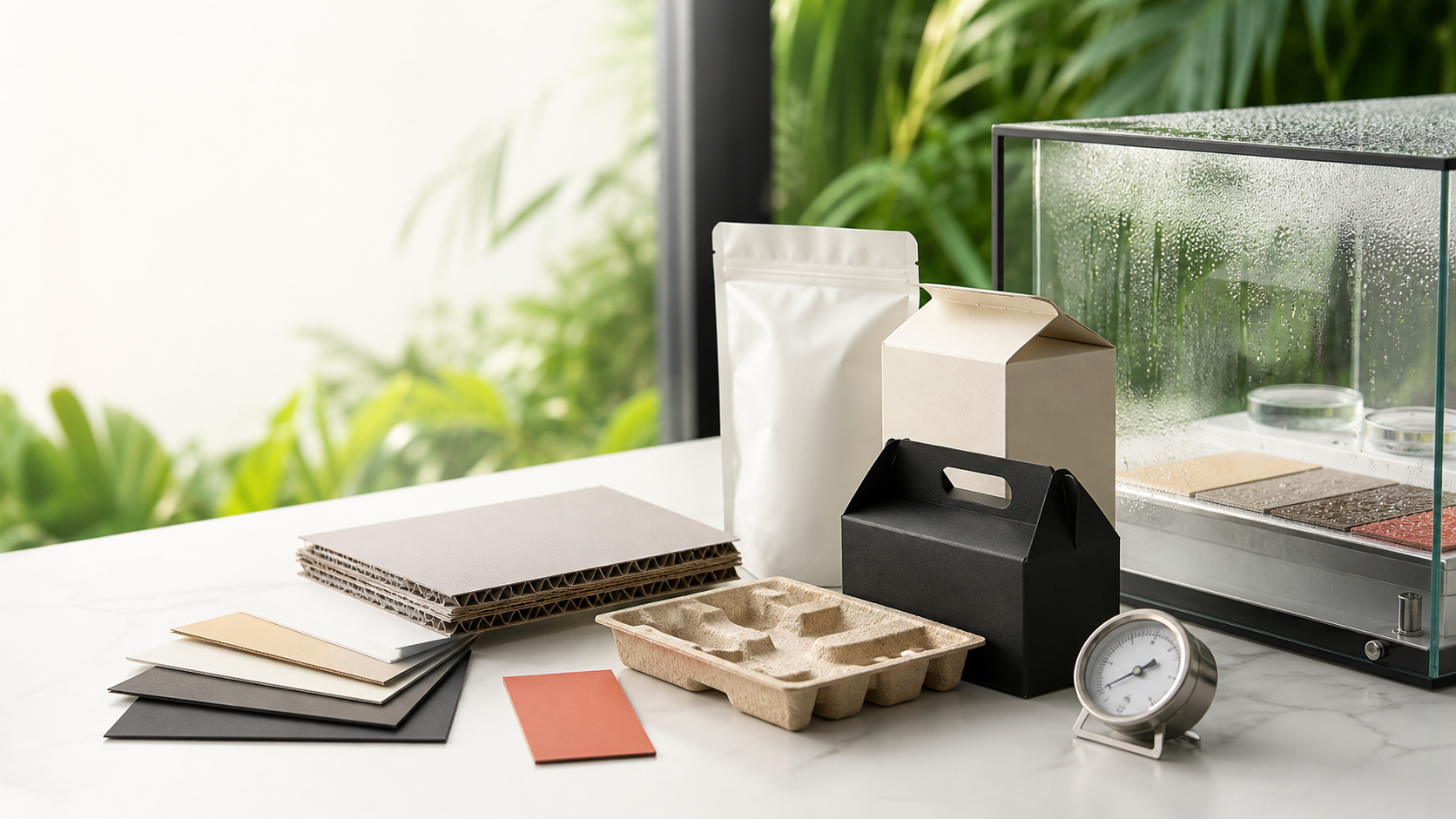
A carton can pass approval in an air-conditioned meeting room and still arrive softened, scuffed or stained after a humid warehouse dwell. For Malaysian procurement teams, operations teams, brand owners and packaging buyers, packaging for hot and humid conditions should therefore be selected against the complete distribution journey—not a dry-condition material datasheet.
The central decision is straightforward: define the product’s failure modes, map its exposure to humidity and temperature changes, and validate the complete filled pack under representative conditions. Malaysia’s average daily maximum relative humidity is generally above 94% and can reach 100%, so moisture exposure is a normal design input rather than an exceptional event.
A packaging specification is only as credible as the journey it represents.
1. Select For The Distribution Journey, Not The Material Datasheet
Malaysia combines relatively uniform annual temperatures with high humidity and abundant rainfall. However, stable annual averages can conceal meaningful temperature changes within a day, at loading areas and during movement between air-conditioned, refrigerated and ambient spaces.
A dry board-strength value, film-barrier result or adhesive specification may be useful for comparing components. It does not by itself show how the filled package will perform after humid storage, temperature cycling, stacking, vibration and repeated handling.
The relevant packaging system may include several coordinated layers:
- A primary pack that controls moisture, contamination or oxygen exposure.
- A closure and seal that preserve the barrier during storage and handling.
- A secondary pack that provides presentation, grouping or additional protection.
- A corrugated transport case designed for the intended stack load and dwell time.
- Cushioning, dividers or fitments that prevent movement and barrier puncture.
- A pallet pattern, stretch wrap and edge protection that stabilise the unit load.
- Environmental controls, liners, corrosion protection or drying agents where justified.
Premium presentation must also survive distribution. A finish that looks refined at artwork approval can lose its intended effect if the surface curls, clouds, scuffs, stains or delaminates before the customer sees it.
Key takeaway: approve protection and presentation after realistic exposure, not only when samples are new and dry.
2. Build A Malaysia-specific Exposure Profile Before Comparing Formats
Begin by turning the route, shipment timing and handling sequence into a written exposure profile. This prevents different packaging proposals from being evaluated against different assumptions.
Record Origin, Destination And Shipment Timing
- Where will goods be packed, stored, consolidated and delivered?
- Will the route involve ports, coastal locations, inland locations, cross-docks or non-air-conditioned warehouses?
- Will loading occur at enclosed bays, covered-but-open areas or exposed kerbsides?
- Could cartons be placed temporarily on damp pallets, wet floors or uncovered staging areas?
- What are the expected and worst-case shipment months?
Rainfall patterns are not uniform across Malaysia. East-coast Peninsular Malaysia commonly experiences maximum rainfall from November through January, while many other areas have peaks around April–May and October–November. A route-specific specification is therefore more useful than a generic “tropical” requirement.
Map Temperature Changes, Not Only Maximum Temperature
Malaysia’s annual temperature variation is generally below 2°C, but typical daily ranges are approximately 5–10°C near the coast and 8–12°C inland. These changes can matter when packages repeatedly move between cool interiors and warm, humid loading areas.
- Will packs move from an air-conditioned packing room into an ambient warehouse?
- Will chilled goods be inspected or transferred in warm humid air?
- Could sun-heated vans or freight containers exceed the reported ambient temperature?
- How frequently will packages cross between temperature zones?
- How long will they remain in each zone before the next transition?
Create A One-page Exposure Profile
The profile should record the route, shipment month, temperature and humidity range, transition frequency, possible rainfall contact, storage duration, stack pattern, transport mode and credible handling events. It becomes the common comparison basis for packaging for humid climates.
| Exposure factor | What to record | Why it changes the decision |
|---|---|---|
| Humidity | Expected level, duration and recovery periods | Affects board moisture, adhesives, labels and surface appearance |
| Temperature | Range, transition speed and frequency | Influences condensation, closure behaviour and material movement |
| Rain contact | Loading exposure, wet floors and damaged wrap | Creates direct water-contact and edge-wicking risks |
| Storage | Normal and delayed dwell times | Changes creep, compression and moisture-uptake assumptions |
| Handling | Transfers, drops, vibration and restacking | Tests seals, cushioning and unit-load stability |
3. Start With Product Failure Modes And Acceptable Shelf Condition
Do not purchase broad protection before identifying what must be protected. A moisture-sensitive powder, a corrosion-prone metal component and a premium gift carton can travel on the same route yet require different control strategies.
Product Sensitivity Checklist
- Moisture uptake: Consider foods, powders, hygroscopic ingredients, electronics, paper goods and products whose texture or dimensions change with humidity.
- Corrosion or oxidation: Identify exposed metal parts, tools, components and sensitive assemblies.
- Microbial or mould risk: Review products and porous components whose safety, usability or appearance may be affected by prolonged dampness.
- Temperature sensitivity: Record approved storage limits for regulated, chilled or otherwise sensitive goods.
- Appearance sensitivity: Identify cartons, labels, foils, coatings and unboxing elements that must remain visually consistent.
- Mechanical sensitivity: Account for fragile products, heavy contents, liquids and items that may shift, leak or puncture a barrier.
Turn Vulnerability Into Acceptance Criteria
Each important failure mode needs an observable or measurable limit. Agree these limits before samples are tested, rather than deciding whether damage is acceptable after it appears.
- Maximum permissible moisture gain, corrosion, deformation or leakage.
- Minimum remaining seal integrity, compression performance and cushioning function.
- Permitted label movement, edge lift, colour change, scuffing or surface distortion.
- Required shelf life and the portion spent inside each packaging level.
- Receiving conditions that trigger acceptance, investigation, quarantine or rejection.
“Water-resistant,” “moisture-resistant” and “moisture-barrier” are not interchangeable claims. For any moisture resistant packaging Malaysia proposal, request the applicable test method, sample construction, exposure conditions, duration and pass criterion.
4. Compare Materials As One Moisture-management System
Material selection should follow the path moisture can take through the finished pack. A strong flat film result offers limited comfort if moisture enters through seals, folds, dispensing features, windows or repeated openings.
Primary Packs And Flexible Barriers
- Compare water-vapour barrier performance under relevant test conditions.
- Ask whether reported figures apply to the finished pack or only to an unconverted film.
- Check seal integrity, puncture resistance and compatibility with the product.
- Evaluate the effects of folds, spouts, zips, valves, windows and repeated opening.
- Inspect whether the product or an internal component could abrade or puncture the barrier.
Paperboard And Premium Rigid Cartons
Paper-based structures can deliver tactile warmth, crisp printing and strong premium perception. Their exposed fibres, cut edges and multiple bonded layers also require attention under humid conditions.
- Assess edge wicking, dimensional stability and resistance to warping.
- Check whether coatings, laminates and adhesives remain compatible after conditioning.
- Inspect surface marking where condensation droplets or damp handling could occur.
- Determine whether the structure recovers after returning to a controlled environment.
A coating may improve resistance to brief contact without making a paper-based structure hermetic. Ask what exposure the coating is designed to withstand and what remains unprotected at edges, folds and openings.
Plastics, Metals And Other Rigid Containers
- Compare barrier performance and closure design as a system.
- Check liner compatibility, torque retention and resealing consistency.
- Assess stress cracking, denting, corrosion and dimensional response to temperature.
- Determine whether a heavy rigid format adds needed protection or mainly increases presentation weight, storage volume and transport load.
Labels, Inks, Adhesives And Decorative Finishes
Visual mock-up approval and distribution-performance approval are separate decisions. Labels and finishes should be evaluated on the production-intent substrate after condensation, chilling, rewarming, abrasion and handling.
- Check label adhesion, edge lift, movement and readability.
- Inspect ink rub, coating clouding, foil adhesion and laminate lifting.
- Compare embossing definition before and after conditioning.
- Assess whether fingerprints, water spots and scuffs become more visible on dark or highly uniform surfaces.
For a deeper comparison of two premium surface treatments, review matte lamination versus soft-touch coating in relation to handling, appearance and durability.
Premium-perception principle: a restrained surface that arrives consistently can communicate higher quality more reliably than several decorative layers with additional interfaces and failure points.
5. Design Condensation Control In Packaging Around Dew-point Transitions
Moisture inside a closed freight container may come from the cargo, porous packaging, timber bracing, pallets or loading during hot, humid or rainy conditions. Temperature changes can then cause water to condense on the container or cargo.
This creates two related hazards. Container sweat forms on the internal surfaces of the transport unit and may drip onto cargo. Cargo sweat forms when warm humid air contacts cargo that remains colder than the surrounding air.
Questions To Ask About The Enclosed Load
- Which materials bring moisture into the load?
- Could pallets, timber bracing or porous packaging release moisture during transit?
- Will chilled goods encounter warm humid air during loading, inspection or delivery?
- Is the barrier continuous after sealing, palletisation and handling?
- Could trapped moisture remain beside the product while the outer carton looks dry?
- Are wet or moisture-releasing materials sharing the same enclosed space?
Control Options To Evaluate
- Dry and condition the product, pallets, bracing and porous packaging before loading.
- Limit exposure during rainy loading and temperature-zone transitions.
- Use a suitable sealed barrier when product sensitivity warrants one.
- Add liners or corrosion protection when supported by the identified failure mode.
- Keep moisture-sensitive cargo away from wet or moisture-releasing materials.
- Specify ventilation only when it is compatible with the cargo and route; ventilation is not a universal solution.
Do Not Specify Drying Agents By Sachet Count Alone
Require a documented desiccant calculation for packaging based on enclosure volume, barrier permeability, initial moisture, route duration, expected conditions and the drying agent’s usable absorption capacity. The calculation must also reflect leakage paths and the amount of moisture introduced by porous materials.
An arbitrary number of sachets may be too little to control the risk or more than the system needs. It can also distract from a wet pallet, poor seal or uncontrolled loading process that should be corrected at source.
6. Specify Corrugated Cases For Humid Stacking And Actual Dwell Time
Controlled testing shows that corrugated box compression strength decreases as relative humidity rises and varies with the board’s moisture content. High humidity also acts over time: prolonged exposure can reduce box hardness even when no single event appears severe.
This challenges a common shortcut. Increasing board weight may add cost and material without resolving weak case geometry, unsupported corners, pallet overhang or an unrealistic stack pattern.
What Buyers Should Request
- Board construction, flute profile, paper combination and relevant strength values.
- Evidence from complete, filled cases rather than component data alone.
- Results after temperature and humidity conditioning representative of the route.
- Maximum stack height, pallet pattern, load distribution and warehouse dwell time.
- A documented margin for misalignment, pallet gaps, overhang, vibration and repeated handling.
Design Details That Influence Stacking Performance
- Case dimensions and panel aspect ratio.
- Hand holes, perforations and other reductions in panel area.
- Print, coating or treatment coverage.
- Internal fit and whether the contents support or distort case walls.
- Closure method and its performance after humid conditioning.
- Pallet deck gaps, stretch wrapping, edge protection and overall unit-load stability.
Humidity resistant corrugated packaging should be written as a performance requirement, not accepted as a grade name. Compare conditioned stacking results under the intended load pattern before approving a heavier specification.
A Practical Comparison Example
Consider two cases with similar dry-condition ratings. One fits its contents closely, aligns its corners with the cases below and remains within the pallet footprint. The other contains void space, spans wide pallet gaps and overhangs the deck.
The first may retain useful stacking performance with less material because its structure and load path are better controlled. The second can fail despite a nominally stronger board because humid conditioning compounds poor unit-load geometry.
7. Include Storage Duration And Transport Handling In The Commercial Brief
Exposure is cumulative. A package that tolerates a brief humid transfer may not retain the same geometry or stacking capacity after several weeks in a non-air-conditioned warehouse.
Storage-duration Questions
- What are the normal and worst-case dwell times at the packer, consolidator, port, warehouse, retailer and customer?
- Are cartons continuously stacked, broken down and restacked, or stored in partial loads?
- Is stock rotation reliable?
- What happens during shipping, customs or receiving delays?
- Must the consumer-facing pack remain pristine after weeks inside a humid secondary case?
Transport And Handling Questions
- Which legs use parcel networks, vans, lorries, sea freight, air freight or temperature-controlled transport?
- How many manual transfers, conveyor events, forklift movements and pallet restacks are credible?
- Which drop orientations, vibration levels, compression loads and load shifts matter?
- Could water enter through open vehicle doors, damaged stretch wrap or temporary staging?
- Could the pack be handled while its surface is damp or softened?
Use An Innovation Filter
Evaluate packaging innovations against a named failure mode and measurable outcome. Easy-open features, lighter structures, novel fibre formats, coatings, smart indicators and reusable systems should be tested within the real distribution sequence before adoption.
For example, a lighter case is a meaningful innovation if it retains the required conditioned stacking performance and reduces system burden. It is not an improvement if warehouse dwell creates crushing, rework or rejection that the heavier design avoided.
8. Validate The Finished Pack Under Shipment-specific Conditions
Packaging for hot and humid conditions should be approved through a documented sequence that conditions the complete filled pack and then reproduces the critical stacking, vibration and handling hazards. Component certificates can inform this process, but they do not replace finished-pack evidence.
Suggested Packaging Validation Testing Sequence
- Define the distribution profile. Record the route, shipment timing, climate transitions, dwell time, stack load, transport mode and handling events.
- Condition the complete pack. Use ISO 2233 packaging conditioning or another justified protocol, with recorded temperature, relative humidity, duration and sample arrangement.
- Test compression and stacking. Apply an appropriate complete-package method, such as ISO 12048, using the intended load pattern and documented dwell assumptions.
- Test vibration. Use ISO 2247 or another justified simulation that represents the relevant repetitive-shock or vibration hazard.
- Select an ISTA procedure deliberately. Distinguish basic screening from partial or general simulation, then match the procedure to package mass, shipment mode and expected hazards.
- Inspect every layer. Examine the product, barrier, seals, labels, finishes, cushioning, closures, cases and unit load.
- Run a controlled shipment trial. Instrument critical routes when laboratory assumptions require confirmation.
Conditioning should occur before the mechanical test when the objective is to understand how humidity changes package performance. Testing a dry case and then storing it in humidity answers a different question.
Agree Pass/fail Criteria Before Testing
- No unacceptable product damage, contamination, moisture gain, corrosion or leakage.
- Specified remaining stack integrity and package geometry.
- No critical seal, closure, label, adhesive or barrier failure.
- Defined cosmetic tolerance for premium surfaces and printed elements.
- Traceable samples, conditioning records, test sequence and deviations.
ISO 2233:2000 covers the conditioning of complete, filled transport packages and unit loads before testing and remained current after confirmation in 2022. The important buyer action is to document the chosen atmosphere and duration so competing proposals can be compared on the same basis.
9. Add Stricter Controls For Regulated And Temperature-sensitive Products
Cold chain packaging Malaysia decisions require a defined product temperature profile, qualified equipment and documented receiving controls. A generic insulated box or a single ambient test does not demonstrate suitability for every regulated or temperature-sensitive product.
Controls For Pharmaceuticals, Cosmetics And Other Sensitive Goods
- Define the approved product temperature profile and any humidity limits.
- Use a fully qualified delivery-container system capable of maintaining that profile.
- Plan continuous maximum and minimum temperature monitoring.
- Add humidity monitoring where product risk requires it.
- Map storage-area temperatures and identify persistent hot or cold locations.
- Specify checks for tampering, contamination, damage and missing records.
- Pre-agree quarantine and investigation rules for excursions, damaged seals and suspect containers.
Receiving-control Template
- Shipment identification, batch information and traceability records.
- Container, closure and tamper-evidence condition.
- Temperature and humidity record review.
- Visible moisture, staining, mould, corrosion, crushing or leakage.
- Any evidence of contamination or unauthorised opening.
- Disposition authority and escalation route.
Receiving criteria should be agreed before purchase. Otherwise, the buyer may receive a technically ambiguous shipment with no shared rule for deciding whether it is acceptable, requires investigation or must remain quarantined.
10. Use A Buyer Scorecard To Reach A Defensible Final Decision
A scorecard converts technical evidence into a commercial comparison. Weight the categories according to product risk rather than assigning equal importance to every feature.
| Decision category | Evidence to compare | Typical warning sign |
|---|---|---|
| Product protection | Barrier, seal, corrosion, contamination and damage results | Claims based only on flat material samples |
| Distribution performance | Conditioned stacking, vibration, handling and route-trial evidence | Dry-condition ratings used as the final answer |
| Duration | Performance across expected and delayed dwell | No allowance for storage creep or moisture uptake |
| Presentation | Colour, texture, label and finish after exposure | Approval based only on pristine mock-ups |
| Operations | Packing, closure, pallet efficiency, storage and inspection | A complex system without process controls |
| Evidence quality | Methods, conditioning, samples, acceptance criteria and reports | Untraceable claims or unmatched test conditions |
| Risk and cost | Total system cost versus damage, spoilage, rework and rejection | Selection based only on unit price |
Ten Final Questions For Packaging Partners
- Which exact product, route and shipment assumptions support the recommendation?
- Which component is the principal moisture barrier, and what happens at seals, edges and openings?
- What test conditions and durations support each performance claim?
- Was the complete filled package tested after humid conditioning?
- How was long-duration stacking represented?
- How are dew-point transitions and condensation risks managed?
- If drying agents are proposed, where is the capacity calculation?
- How were labels, adhesives and premium finishes evaluated after conditioning?
- What changes if the month, route, dwell time or pallet pattern changes?
- What are the written receiving, quarantine and rejection criteria?
Common Buyer Questions
Is a waterproof outer coating enough for a paper-based package?Not necessarily. A coating may reduce brief surface contact while cut edges, folds, closures and internal paper layers remain vulnerable. Evaluate the complete structure after the expected exposure and handling sequence.
Should buyers simply specify a stronger corrugated grade?Only after checking case geometry, internal fit, pallet support, stack alignment and conditioned test results. More material cannot reliably compensate for an uncontrolled load path or unrealistic dwell assumption.
Do all humid routes require desiccants?No. The decision depends on the product, enclosure, moisture sources, barrier performance, leakage, duration and temperature transitions. Where drying agents are justified, calculate the required usable capacity.
Can one laboratory procedure prove the package is suitable?Usually not. Conditioning, compression, vibration, handling inspection and a controlled route trial answer different questions. Use the smallest defensible sequence that represents the material risks of the shipment.
Neutral Next Step
Prepare the exposure profile and buyer scorecard, shortlist the minimum viable packaging systems, and request comparable conditioned-test evidence. Where evidence is incomplete, run a small validation batch before approving tooling, artwork or full-volume purchasing. This is the most practical way to turn packaging for hot and humid conditions from a broad claim into a defensible buying requirement.
References
- Malaysian Meteorological Department — Malaysia’s Climate
- Clemson University — Relative Humidity Effects on the Compression Strength of Corrugated Boxes
- Characteristics of Moisture Absorption to Corrugated Packaging Box for the Cold-Chain System
- UNECE CTU Code — Introduction and Condensation Damage
- UNECE CTU Code — Mechanisms of Condensation
- ISO transport-package standards: ISO 2233, ISO 12048 and ISO 2247
- International Safe Transit Association — Test Procedure Overview
- Malaysia NPRA — Guidelines on Good Distribution Practice, Third Edition