Field note
Paperboard vs Corrugated Packaging for Malaysian E-Commerce Brands
A practical guide for Malaysian e-commerce brands comparing paperboard and corrugated packaging by protection, presentation, storage and shipping needs.
Published 23/07/2026
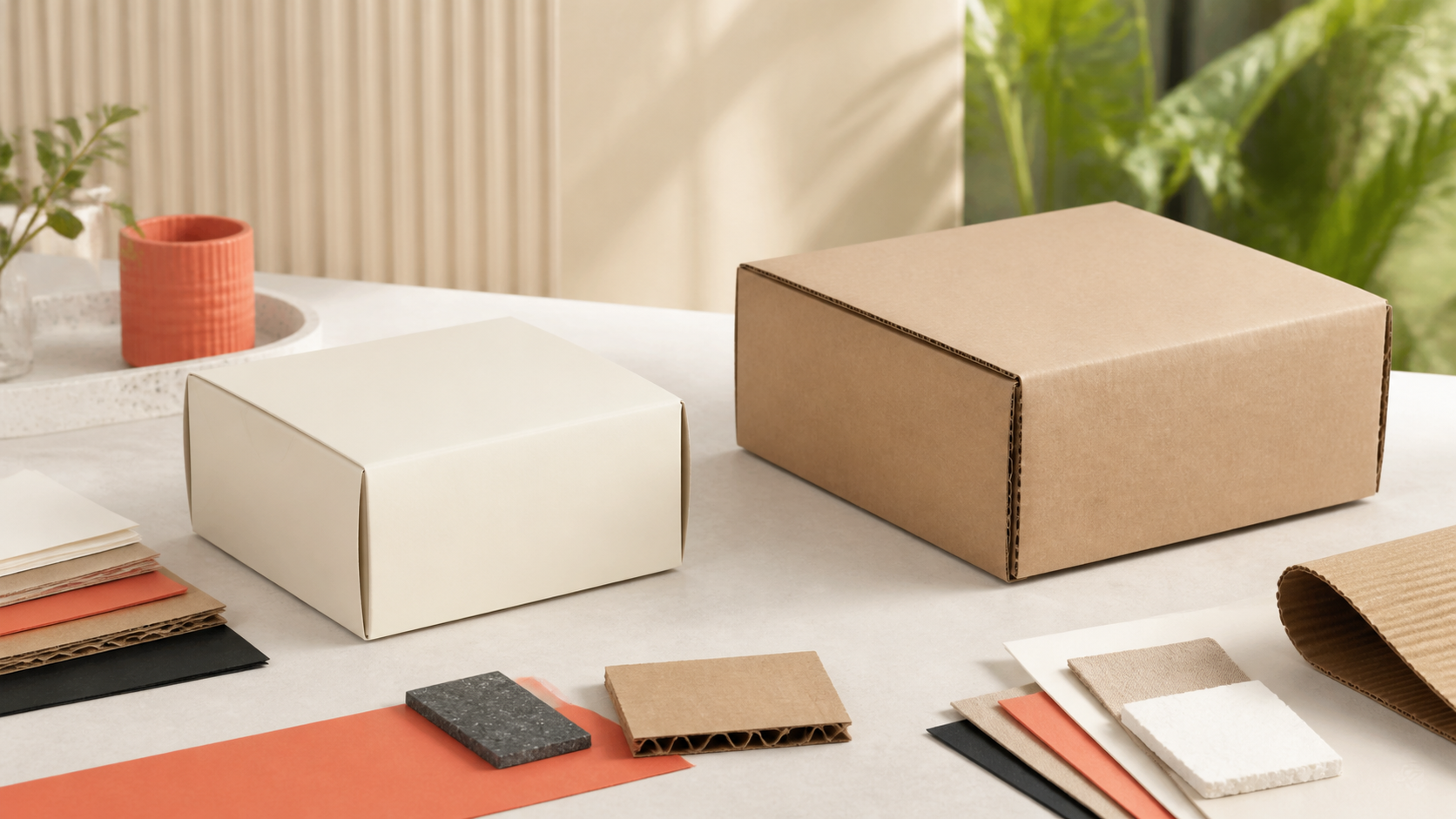
For Malaysian e-commerce brands, choosing the wrong box can turn attractive packaging into damaged stock, slower packing and unnecessary delivery volume. In paperboard versus corrugated packaging, paperboard usually suits light, presentation-led products, while corrugated board is the safer starting point for direct parcel shipment, heavier goods and fragile items. This guide is for brand owners, procurement teams and operations managers deciding how to balance protection, presentation, storage and distribution risk.
Key Takeaway
Choose the packaging role before choosing the material. Use paperboard when graphics, compactness and a controlled opening experience lead the decision. Use corrugated board when the package must survive parcel handling, stacking and longer distribution routes. Use both when the product needs a presentation carton and a separate transport layer.
The best-looking box is not necessarily the best shipping system, and the strongest-looking box is not necessarily the most efficient one.
1. Which Material Should A Malaysian E-commerce Brand Choose?
The direct answer depends on six variables: packed weight, fragility, route, climate exposure, presentation requirements and the consequences of failure. A lightweight skincare tube sold in a branded folding carton presents a different risk from a glass bottle moving through several parcel-handling stages.
Material names alone do not establish performance. Board grade, flute profile, box dimensions, structural design, inserts, closures and packing method can change the outcome substantially. An oversized corrugated box with poor movement control may protect a product less effectively than a compact, properly engineered pack.
Malaysian buyers should also consider humid storage, rainfall exposure, courier handling and potentially longer delivery windows between Peninsular and East Malaysia. Dimensional-weight charging makes excess volume a commercial issue as well as a material issue.
| Decision factor | Paperboard | Corrugated board |
|---|---|---|
| Structure | Relatively thin board commonly cut, creased and folded into cartons | Flat liners joined to a fluted medium that creates depth and rigidity |
| Typical role | Primary or secondary presentation packaging | Shipping, distribution or protective outer packaging |
| Presentation | Well suited to detailed graphics, controlled folds and refined surfaces | Can be printed effectively but usually has a more structural character |
| Protection | Suitable for light products with limited exposure to crushing and impact | Better starting point for stacking, impacts, heavier goods and parcel handling |
| Storage before packing | Often supplied flat and stored compactly | Flat blanks store efficiently; pre-erected formats require more space |
| Packing process | May require carton erection, inserts and an outer shipper | May require erection, cushioning, void control and secure sealing |
| Direct parcel suitability | Usually limited unless structurally reinforced or protected by an outer pack | Commonly used as the direct-shipping format |
2. Paperboard And Corrugated Board Are Structurally Different Materials
Paperboard Is Thin Board Designed For Folding And Presentation
Folding cartons commonly use board in the range of 10 to 36 points. They can arrive flat, conserving storage and inbound transport space before they are erected for packing. Cosmetics, personal-care products, supplements, confectionery and small electronics accessories are familiar applications.
Paperboard packaging for e-commerce often works best as primary or secondary presentation packaging rather than as an unsupported parcel container. It can create precise panels, sharp fold lines and a controlled opening sequence, but conventional folding cartons are generally less strong than rigid boxes or corrugated shippers.
Mini-flute constructions occupy a useful middle ground. Their fluted structure can provide more cushioning and rigidity than conventional paperboard while retaining a relatively refined presentation surface. Actual suitability still depends on the product and tested pack design.
Corrugated Board Uses Liners And Flutes To Create Rigidity
Corrugated board consists of flat liners surrounding a wavy fluted medium. The connected arches of the flutes resist deformation and help the board withstand handling and stacking forces. Air held within the flutes also provides a degree of insulation against temperature variation, although it does not create controlled-temperature packaging.
Single-wall and double-wall constructions provide different structural options. Double-wall board adds another fluted layer and liner, but no universal weight limit should be inferred from the construction name alone. Board specification, box shape, dimensions, storage conditions and load duration all affect performance.
Corrugated packaging for e-commerce is commonly used as tertiary packaging or as the direct parcel shipper. Its advantage is not simply thickness: the geometry of the complete structure is what produces much of its rigidity.
3. Match The Structure To Weight, Fragility And Failure Consequences
When Paperboard Is Likely To Be Sufficient
- The product is light, compact and not highly sensitive to crushing, puncture or repeated impacts.
- The order will be handed directly to the customer or placed inside a protective courier pack.
- Detailed graphics, shelf presence and a controlled opening sequence matter more than standalone shipping strength.
- Minor carton scuffing or corner deformation would not compromise product safety or function.
When Corrugated Board Is The Safer Starting Point
- The order is heavy, delicate, irregularly shaped or contains several products.
- The parcel will encounter stacking, drops, vibration or automated handling.
- Leakage, breakage or deformation could damage adjacent goods or trigger an expensive return.
- The route includes extended storage, multiple transfers or meaningful moisture exposure.
Shipping guidance commonly recommends corrugated cartons for parcel transport and double-wall boxes as a starting consideration for heavy or delicate products. That recommendation does not replace testing: an unsuitable size, weak closure or poor internal restraint can undermine a robust board grade.
When A Hybrid Pack Earns Its Additional Layer
A hybrid system separates brand presentation from transport protection. A printed folding carton controls the product reveal, while a right-sized corrugated outer box absorbs the harsher conditions of distribution.
The trade-off is additional material, dimensional volume and packing work. Buyers should therefore compare total delivered outcomes—including damage, returns, packing time and presentation—rather than selecting on unit packaging price alone.
| Product profile | Standard presentation | Premium presentation |
|---|---|---|
| Low weight, low fragility | Paperboard may be sufficient for controlled delivery; assess whether an outer mailer is required | Printed paperboard carton, with a right-sized shipper if parcel exposure is meaningful |
| Low weight, high fragility | Corrugated pack with a fitted insert or cushioning | Paperboard presentation carton inside a corrugated shipper |
| High weight, low fragility | Corrugated structure selected for load and route conditions | Printed corrugated pack or a separate presentation layer where justified |
| High weight, high fragility | Tested corrugated system with restraint, cushioning and secure closure | Tested hybrid system, provided the extra layer improves a defined outcome |
4. Paperboard Vs Corrugated Box Protection Depends On The Complete Pack
Protection must be evaluated across compression, crushing, puncture, vibration and drop risks. The outer box is only one component. Inserts, dividers, moulded paper parts, cushioning, void fill and closures determine how forces reach the product.
For example, a small glass jar placed against the wall of a large shipping box can receive impact forces directly. Centring the product and maintaining suitable clearance creates space for protective material to manage those forces. Packing guidance recommends at least 6 cm between the product and the outer walls, with empty space filled to restrict movement.
This clearance is a useful starting point, not a substitute for product-specific engineering. A light textile item and a heavy metal component do not need the same cushioning response. Delicate surfaces may also need protection from abrasion even when breakage is unlikely.
Overpacking is a design failure when added volume or material does not measurably reduce damage. The objective is not the largest possible box; it is the smallest validated system that restrains the product and survives the relevant hazards.
5. Corrugated Box Testing Standards Should Follow The Likely Failure Mode
Appearance cannot confirm whether a package will survive distribution. Corrugated materials and completed boxes can be evaluated for burst strength, puncture resistance, flat crush, edgewise crush, water absorption, glue-bond water resistance, box compression and vertical drop impact.
Not every package requires every test. A stack-sensitive product may justify close attention to compression performance, while a sharp or irregular component may make puncture resistance more important. The test programme should reflect the actual product, route and failure consequences.
Test The Final Configuration, Not An Isolated Empty Box
Generalised e-commerce fulfilment testing can reproduce hazards encountered between retailer fulfilment and final delivery. Over-boxing protocols similarly evaluate tertiary shipping cartons against combinations of vibration, shock and handling stress.
The product, insert, closure and shipping carton should be tested together in their final configuration. Changing the tape pattern, insert material, product orientation or packed weight after testing can change the system being evaluated.
Define Success Before Testing Begins
- No breakage, leakage or release of loose components.
- Continued product function after the test sequence.
- Acceptable cosmetic condition for the product and presentation pack.
- No closure failure or product movement beyond the agreed tolerance.
- Enough remaining box integrity for safe handling at delivery.
A clear pass threshold prevents a dented box from being dismissed as harmless when appearance is commercially important—or treated as a failure when the shipper successfully sacrificed itself to protect the product.
6. Moisture-resistant Packaging Malaysia Requires Route-level Thinking
Malaysia has high humidity and abundant rainfall. During the northeast monsoon, heavy rain spells can affect the east coast of Peninsular Malaysia, western Sarawak and northeastern Sabah. Packaging may encounter moisture at storage areas, loading bays, collection points, delivery vehicles or an exposed doorstep.
Humidity and board moisture content can reduce corrugated edge-crush strength and ultimate stacking performance. A box that performs well in a dry sample room may behave differently after conditioning in a humid environment or after prolonged storage.
Moisture resistance is not the same as waterproofing. Untreated fibre packaging should not be represented as waterproof, and a surface treatment does not necessarily protect exposed edges, cut-outs, glue joints or closures.
Practical Controls Before Adding Complex Barriers
- Store unused cartons in a dry, covered area with suitable inventory turnover.
- Keep blanks and erected cartons away from wet floors and walls.
- Use covered loading areas and suitable pallet protection where exposure is plausible.
- Apply closures consistently and examine whether water can enter through seams.
- Condition test samples for the expected climate rather than testing only in ideal room conditions.
- Inspect the weakest part of the route, not merely the longest part.
Coatings and laminations may improve selected barrier or rub-resistance properties, but they can also change print response, fold behaviour, converting requirements and end-of-life pathways. Evidence should apply to the precise combination of board, treatment, adhesive and structure under consideration.
7. Storage, Packing Speed And Distribution Routes Affect Total Cost
Storage Before Use
Folding cartons can arrive flat, reducing the space needed before pack-out. Corrugated blanks can also be stored flat, while pre-erected boxes trade storage density for faster or simpler packing.
Neither format should be evaluated on nominal dimensions alone. Humidity management, warping, inventory turnover and protection from wet surfaces affect whether stored packaging remains usable and easy to erect.
Packing During Normal And Peak Periods
Measure carton erection, insert placement, void fill, sealing, label placement and quality checks. A pack that performs well when assembled slowly by its designer may become inconsistent during a campaign peak.
Complexity deserves suspicion when it cannot be connected to protection or presentation. Too many loose components, ambiguous fold sequences and closures that can be applied incorrectly increase variation at the packing bench.
Distribution Across Malaysia
Indicative domestic delivery windows can be longer for East Malaysia than for movement within Peninsular Malaysia. These estimates are not guarantees for every shipment, but they illustrate why some parcels may spend more time in storage, handling and transport environments.
Longer routes do not automatically require a heavier box. They justify a closer review of stacking duration, closure integrity, movement control and moisture exposure—especially for products that leak, deform or lose function when damaged.
8. Dimensional Weight Packaging Optimization Starts With A Packed Sample
Malaysian courier charges may be based on the greater of actual weight and dimensional weight. The general dimensional-weight calculation is:
Dimensional weight = packed length × packed width × packed height ÷ applicable DIM factor
If a parcel has packed dimensions of L, W and H, its dimensional weight is L × W × H ÷ D, where D is the carrier's applicable divisor. Buyers should confirm the current divisor, units, rounding method and measurement rules for the selected carrier and service.
Right-sized packaging for shipping reduces avoidable air in folding cartons, corrugated mailers and shipping boxes. Compactness must still leave enough room for cushioning, product clearance and reliable closure; reducing dimensions until the product touches an outer wall can increase damage risk.
Measure several packed production samples rather than relying only on structural drawings. Bulging panels, inconsistent folds, cushioning rebound and overfilled inserts can make the shipped parcel larger than its nominal design.
Mixed baskets also matter. A box optimised for one ideal product may perform poorly when a customer orders two units, combines products of different sizes or adds an accessory.
9. Presentation, Finishes And Environmental Claims Need Separate Decisions
Premium Perception Is More Than Material Thickness
Folding paperboard supports consistent colour registration and fine printed detail, making it useful for presentation-led packaging. Its controlled folds and relatively smooth surfaces can create a retail-style experience even when the product is sold online.
Corrugated packaging can communicate practical confidence through restrained graphics, visible material character and a purposeful opening sequence. Premium perception does not automatically require more layers, heavier board or elaborate decoration.
Evaluate print coverage, tactile character, structural reveal, insert fit and the order in which the customer encounters each component. If a soft-feel surface is being considered, compare its handling and durability implications with the broader guidance on matte lamination versus soft-touch coating.
Finishes Change More Than Appearance
- Uncoated surfaces: Can provide a natural tactile character but may respond differently to dense colour and repeated handling.
- Coated surfaces and varnishes: Can alter gloss, print appearance and rub resistance.
- Laminations: Can create a distinct visual and tactile layer but may affect folding, conversion and material recovery.
- Foil effects: Can add targeted contrast but should be assessed on the actual board and artwork.
- Embossing and debossing: Introduce physical relief that can affect panel strength, fine detail and nearby folds.
Prototype on the intended substrate. Colour, texture, foil transfer and fold behaviour can differ between paperboard and corrugated liners, so a screen rendering or flat print proof cannot confirm the finished result.
Sustainable E-commerce Packaging Malaysia Requires Claim-level Evidence
Recovered paper is an important input for recycled pulp, kraft paper and paper packaging in Malaysia. That fact does not make every fibre-based package equivalent. Recycled content, recyclability and lower environmental impact are separate claims that require separate evidence.
The construction must be considered as a whole, including films, laminations, coatings, adhesives, metallic effects and mixed-material inserts. Local collection and recovery pathways also matter when making disposal claims.
Avoiding product damage belongs in the assessment. Saving a small amount of packaging material is not a meaningful improvement if the result is more broken stock, replacement deliveries or discarded products.
Terms such as “eco-friendly,” “biodegradable” and “fully recyclable” should not be used without evidence for the exact construction and relevant Malaysian end-of-life conditions. Material category alone is not proof.
10. A Buyer’s Decision Framework For E-commerce Packaging Malaysia
Paperboard versus corrugated packaging becomes easier to evaluate when the decision is treated as a sequence rather than a material popularity contest.
- Define the product. Record packed weight, dimensions, fragility, surface sensitivity, leakage risk and replacement consequences.
- Map the route. Identify parcel handling, stacking, humidity, rainfall exposure, storage duration and Peninsular-to-East Malaysia distribution where relevant.
- Choose the packaging role. Decide whether the pack is primary packaging, a presentation carton, a shipping container or part of a hybrid system.
- Shortlist structures. Compare folding paperboard, mini-flute, single-wall corrugated, double-wall corrugated and presentation-carton-plus-shipper configurations.
- Right-size the design. Remove unnecessary volume while preserving cushioning clearance, movement control and closure integrity.
- Prototype the experience. Review print, finish, opening sequence, assembly consistency, pack-out time and disposal instructions.
- Test the final packed system. Select methods that reflect actual compression, drop, vibration, puncture and moisture risks.
- Run a controlled shipment trial. Record damage, cosmetic condition, courier exceptions, packing time and customer feedback.
- Compare total outcomes. Include material, labour, storage, chargeable volume, damage, returns and presentation without inventing unsupported costs.
Condensed Recommendation
- Choose paperboard first for light products requiring detailed graphics and a deliberate opening experience, provided distribution exposure is low or a suitable outer shipper is used.
- Choose corrugated first for direct parcel shipment, heavier or delicate products and routes with meaningful compression, handling or moisture risks.
- Choose a hybrid when presentation and transport protection are both essential and trials show that the additional layer produces a worthwhile result.
Frequently Asked Questions
Can A Paperboard Carton Be Shipped Without A Corrugated Outer Box?
Sometimes, but only when the product, construction and route support it. Consider crushing, puncture, rain exposure, label adhesion and the cosmetic condition expected at delivery. A controlled shipment trial is more reliable than deciding from appearance.
Is Double-wall Corrugated Board Always Better?
No. It can provide useful structural capacity for heavy or delicate products, but it may add material and volume without solving poor fit, product movement or weak closure. Select it in response to a defined hazard and verify the completed pack.
Does A Smaller Box Always Reduce Shipping Cost?
No. A smaller external volume may reduce dimensional weight, but insufficient clearance or cushioning can increase damage. The useful target is the smallest validated pack, not the smallest box that can physically contain the product.
Are Fibre-based Boxes Automatically Recyclable?
No. Recyclability depends on the complete construction and the relevant collection and recovery pathway. Laminations, coatings, windows, adhesives and mixed-material components require separate consideration.
What Should A Brand Measure During A Trial?
Track packing time, packed dimensions, closure consistency, product movement, cosmetic condition, damage, leakage, courier exceptions and customer feedback. Compare those results against pre-agreed acceptance thresholds.
Make The Decision With Prototypes, Not Assumptions
The final paperboard versus corrugated packaging choice should follow the product and route. Paperboard provides a strong platform for detailed presentation; corrugated board provides a more suitable starting structure for many parcel hazards; a hybrid pack separates those roles when both matter.
Prepare two or three right-sized prototypes, pack them with the actual product and compare presentation, assembly time, dimensional volume and test performance before making a commercial commitment.